
A growing apparel business can reach a point where buying ready-made transfers starts to limit its delivery schedule. Bringing direct-to-film printing in house can give the team more control, but it also adds equipment, maintenance and another production responsibility. The decision makes sense when the value of that control exceeds the full cost of running the process reliably.
There is no universal number of shirts that makes a DTF printer worthwhile. A shop making repeated large chest prints has a different workload from one producing small names and occasional logos. Before comparing machines, examine the transfers you buy, the time spent waiting for them and the production work your team can actually take on.
Look at the transfer workload you already have
Review several normal weeks alongside a busy period. Record the size and quantity of transfers, their purchase cost, delivery charges, lead time and any replacements. Separate recurring designs from one-off orders. This shows whether there is predictable work for a printer or simply an unusually busy month.
Count printed area as well as garments. Twenty large back designs can use more film than a much larger batch of small logos. Also record urgent changes, such as an extra team member or a corrected name. In-house printing may be useful for those jobs even when a transfer supplier remains competitive for planned batches.
Ask where delays occur. If transfers arrive promptly but finished shirts wait at the heat press, buying a printer will not remove that bottleneck. If production regularly stops while the team waits for a small replacement transfer, local printing addresses a clearer problem.
Compare the full cost of an accepted transfer
An outsourced transfer has a relatively visible price. The invoice, freight and any minimum order charges provide a starting point. Add the labour involved in ordering and receiving it, plus the cost of unusable transfers that the supplier does not replace. Use accepted output as the denominator so both options reflect what can actually be sold.
The internal calculation needs more inputs. Film, ink and adhesive powder are only part of the cost. Include setup and cleaning time, routine maintenance, electricity, replacement service parts, waste from tests and failed prints, software costs where applicable, and the equipment’s financing or depreciation. A person must also prepare the files, monitor production and keep records.
Calculate internal cost using realistic utilisation. Dividing monthly ownership costs by the printer’s maximum possible output can make an underused machine look inexpensive. Divide by the quantity of accepted transfers you expect to produce. Then repeat the calculation with a quieter month and a more difficult waste rate.
To estimate a monthly break-even quantity, divide additional monthly fixed costs by the difference between the outsourced cost per accepted transfer and the internal variable cost per accepted transfer. Keep ownership costs separate from variable production costs for this calculation. If depreciation is included in monthly fixed costs, do not also include it in the cost assigned to each internal transfer.
Variable production costs include the film, ink, powder, output-related labour, electricity and waste attributable to the job. Classify other costs according to how they actually change with output, and use the same accounting basis for both options. Include only the net additional fixed costs of bringing production in house.
The calculation is useful only when the transfer sizes and designs are comparable and the saving per accepted transfer is positive. A job mix with widely varying artwork sizes needs a calculation by printed area or by representative order. Repeat it for quieter months and higher waste. It is a planning estimate, not a promise of profit.
Put a value on delivery control
Lead time matters when it changes the work the business can accept. A printer may allow a shop to replace a damaged transfer, add a name or test a revised design without arranging another delivery. That flexibility has value when customers regularly need those services.
It also creates expectations. If the business promises same-day production, someone must be available to operate and maintain the system. Equipment ownership does not guarantee immediate output. File corrections, nozzle problems and curing issues can still delay a job.
Use records rather than assumptions. Note orders lost because transfers could not arrive in time, extra freight paid for urgent shipments and hours spent managing last-minute changes. These figures make the case for control more concrete than a general wish to print faster.
Plan the whole production process
DTF printing creates colour and white-ink layers on PET film. Adhesive powder is applied to the wet print and cured before the transfer is heat pressed onto a suitable garment. Each step needs compatible materials, equipment settings and handling procedures.
The printer, powdering and curing unit, and heat press must work at a balanced rate. Film handling and cutting also take time. Measure the team’s existing pressing capacity and allow for garment loading, alignment, peeling and finishing. A high printing speed is of little use if transfers accumulate beside the press.
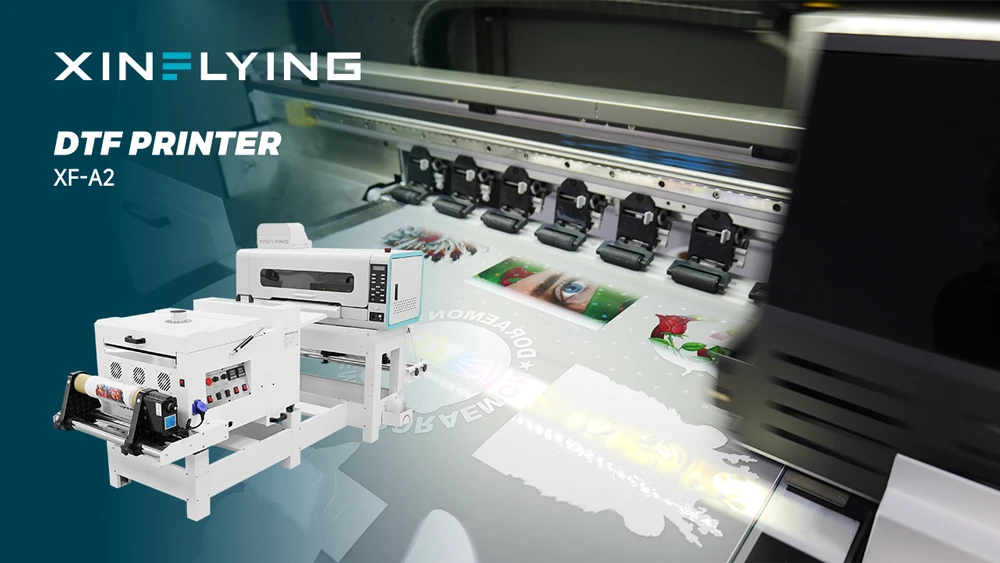
When assessing ownership, compare commercial DTF printer configurations together with their matched powdering and curing equipment. XINFLYING supplies commercial digital printing equipment and related consumables, making its range one example to assess against the shop’s workload. Ask for a production test using representative artwork and an explanation of the labour required. This is more useful than selecting a machine from its maximum speed alone.
Make maintenance somebody’s responsibility
White ink requires the handling and maintenance routine specified for the equipment. The operator needs to understand nozzle checks, cleaning, consumable storage and the warning signs that require support. Occasional production does not automatically mean occasional maintenance.
Assign a primary operator and a trained backup. Establish which tasks happen before printing, after a shift and during planned idle periods. Confirm the supplier’s shutdown procedure before deciding that a printer can sit unused between busy seasons.
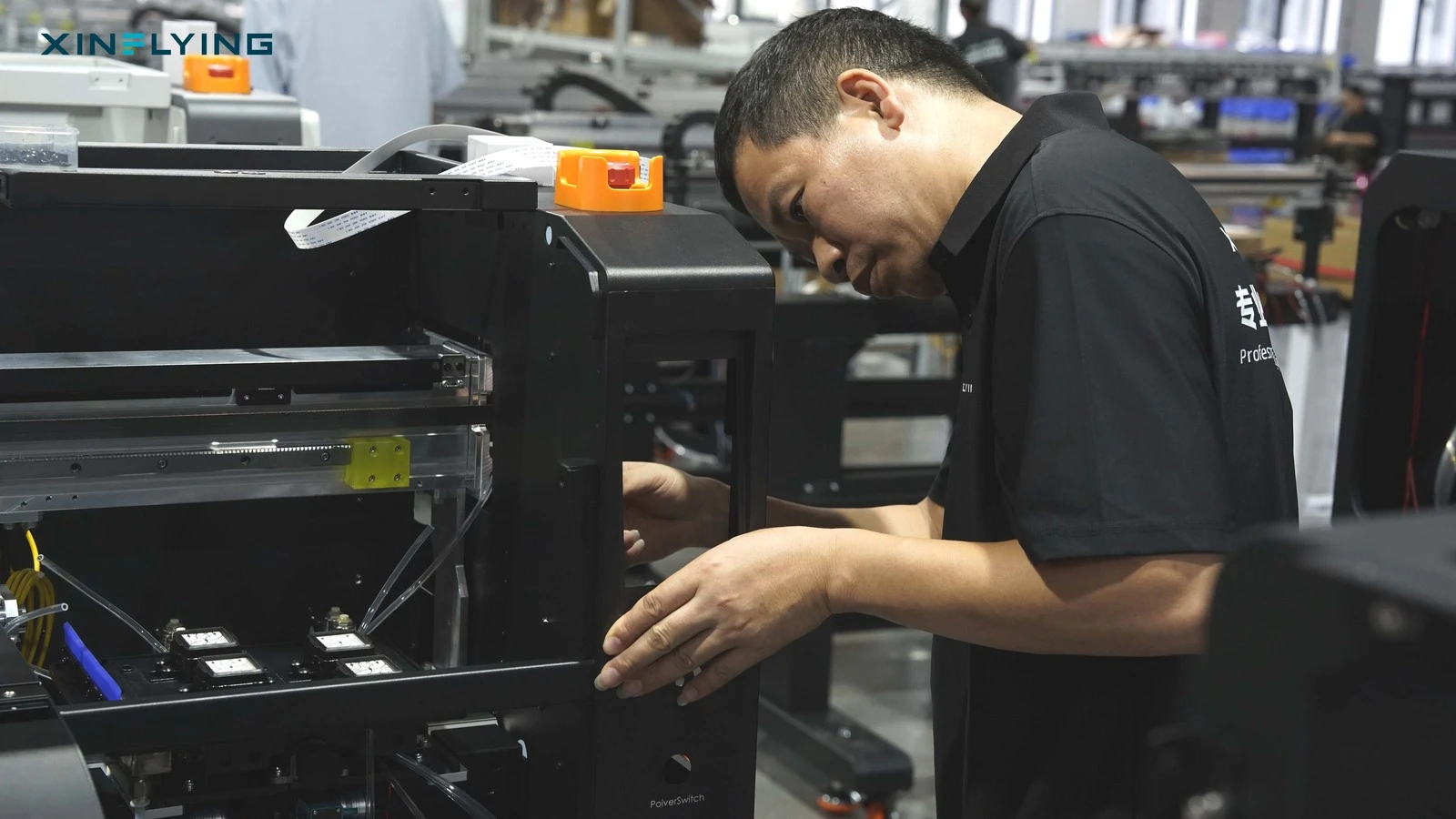
Check parts availability and the support arrangement for the actual model. Ask how a fault is diagnosed, what information the technician needs and which service items should be stocked locally. Downtime belongs in the cost comparison even if it cannot be predicted precisely.
Choose a brand that offers after-sales service
Keep a hybrid option available
Outsourcing and ownership can coexist. A shop may print urgent changes and routine short runs internally while buying large seasonal batches from a specialist. A transfer supplier can also provide backup while equipment is being serviced.
Before changing production, test internal and purchased transfers on the garments customers actually order. Check colour, edge quality, adhesion, feel and performance after washing according to an agreed procedure. Keep records of the film, ink, powder and pressing settings. A transfer that looks attractive immediately after pressing still needs to meet the customer’s use requirements.
Avoid changing suppliers or consumable combinations halfway through an order without testing. Matching the appearance of repeat orders can matter as much as reducing the cost of an individual transfer.
Compare the three arrangements against the shop’s actual constraints. These are decision criteria, not fixed volume thresholds.
| Decision point | Outsourced transfers | In house printing | Hybrid approach |
| Demand fit | Irregular or planned batches | Recurring work with trained staff | Routine work plus variable peaks |
| Daily responsibility | Order, receive and inspect transfers | Prepare files, print, cure and maintain | Internal operation plus supplier coordination |
| Urgent corrections | Depend on supplier lead time | Possible when equipment and staff are ready | Handle locally when practical |
| Capacity limits | Supplier capacity and delivery | Printing, curing and pressing capacity | Internal capacity plus supplier availability |
Decide with a representative production trial
Build the decision around an ordinary order, a busy week’s workload and an urgent correction. For each, compare cost, operator time, accepted output and delivery reliability. Request a supplier demonstration that includes setup and finishing rather than only the fastest printing segment.
Continue buying transfers if volume is irregular, the team is already overloaded or maintenance would be difficult to sustain. Consider internal production when recurring demand, trained staff and delivery needs support the investment. Keep outsourcing available where it remains the better fit. The aim is to complete profitable orders consistently, with a production arrangement the business can support.
About the Author