To become a tree surgeon in the UK, you need chainsaw and climbing certificates from City & Guilds NPTC or Lantra Awards, first aid training, a UK driving licence and supervised site experience. You can start through an apprenticeship, a college course, a degree or a groundworker job. Most people need around two years to climb safely.
Tree work is one of the few skilled trades you can enter without a degree. It is also one of the riskier ones, so the way you train matters. Approved centres such as Brampton Valley Training in Towcester, Northamptonshire, teach the tickets employers ask for.
This guide covers:
- The four main entry routes.
- The exact tickets and what each one costs.
- The laws every new starter must know.
- A realistic timeline from day one to your first climb.
What Does a Tree Surgeon Do?
A tree surgeon, also called an arborist or tree climber, looks after trees. The National Careers Service says the work involves assessing tree health, removing branches, planting new stock and felling unsafe trees. It takes place in parks, gardens, streets, woodland and even on railway land.
A typical job includes:
- Crown reduction, thinning and lifting.
- Removing dead or dangerous branches.
- Dismantling a tree in sections where there is no room to fell it.
- Chipping brash and clearing the site.
- Stump grinding and hedge work.
- Emergency call-outs after storms.
A typical working day:
- Team briefing and vehicle checks.
- Site risk assessment and drop zone set-up.
- Climbing, cutting and rigging.
- Chipping and clearing.
- Loading up and driving to the next job.
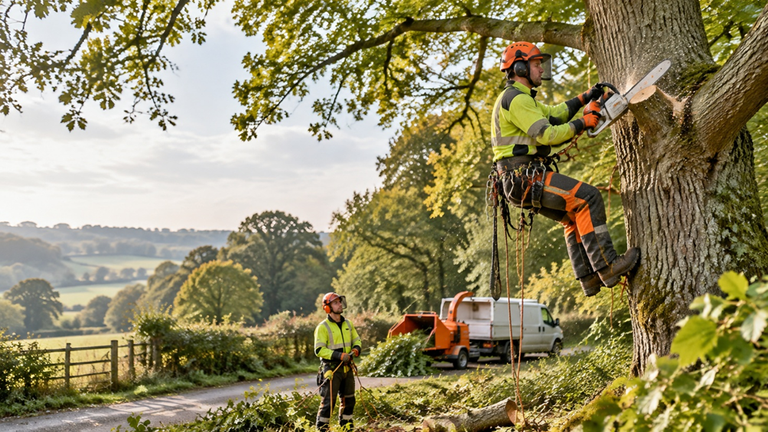
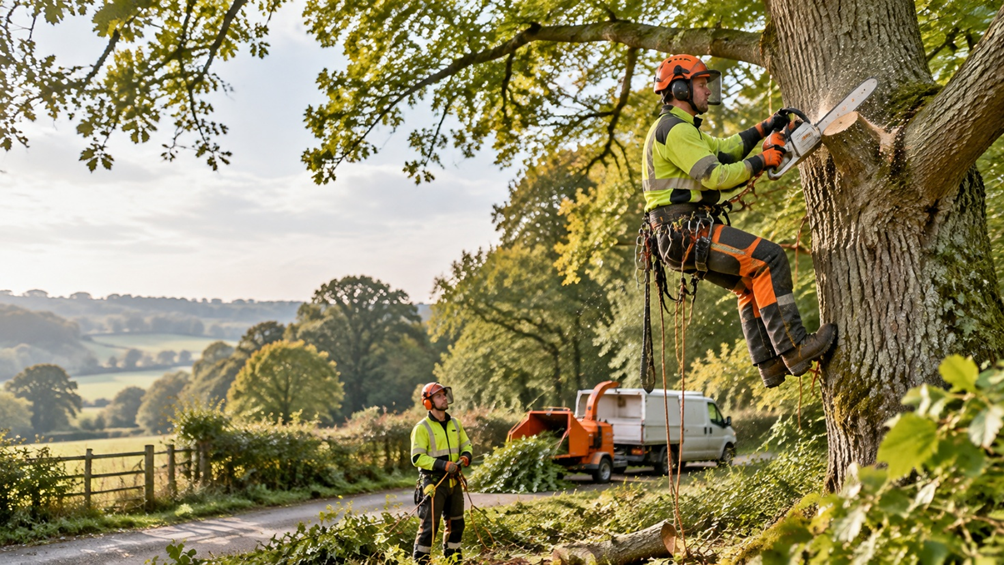
Most crews split into two roles. Ground crew handle ropes, chipping and site safety. Climbers work in the canopy. Almost everyone starts on the ground, and that shapes the training path below.
Is Tree Surgery Right for You?
Tree surgery suits practical, fit people who are happy outdoors in all weather. The National Careers Service lists typical hours of 40 to 43 a week, and some employers expect weekend or short-notice work after storms.
The physical side:
- Heavy lifting and dragging of cut timber.
- Long days in cold, rain or heat.
- Climbing with a loaded harness.
The mental side:
- Staying calm at height.
- Checking risks on every job, even the tenth tree of the week.
- Working in a team where one mistake can hurt someone else.
The risk side:
The risk is real, and you should know it before you pay for any course. The Health and Safety Executive (HSE) says tree work has a major injury rate higher than the construction industry. An HSE-linked analysis of injury reports found that falls from height caused 40% of fatal tree-work accidents over a five-year period. Being struck by a moving or falling object caused another 40%.
Those figures explain why training in this trade is so structured. They are not a reason to stay away. They are a reason to learn properly.
A simple test: ask a local tree firm if you can spend a few days on the ground crew before you spend money on tickets. You will soon learn whether you like the work.
Tree Surgeon Entry Routes in the UK
There are four main ways in: an apprenticeship, a college course, direct entry as a groundworker, or a university degree. Whichever you choose, an approved centre such as Brampton Valley Training can explain which tickets to take first.
| Route | Typical length | Paid while learning? | Best for | Main drawback |
| Apprenticeship | 18 months to 3 years | Yes | School leavers and adults who want a wage | Needs an employer to take you on |
| College course | 1 to 2 years | No | 16 to 19 year olds | Still needs practical tickets and site hours |
| Groundworker | Ongoing | Yes | Career changers | Slow start and low early pay |
| University degree | 2 to 3 years | No | Consultancy and tree officer careers | Less hands-on climbing |
1. Arboriculture Apprenticeship
An apprenticeship lets you earn while you learn. The National Careers Service names the Arborist Level 2 and Forest Craftsperson Level 3 apprenticeships as examples. It says they usually take a minimum of two years and combine on-the-job training with learning off-site. Some listings run shorter, so read each vacancy on Find an Apprenticeship carefully.
The catch is that you need an employer willing to take you on. Contact local tree firms directly as well as checking job boards.
2. College Courses
Land-based colleges run Level 2 and Level 3 courses in forestry and arboriculture. The National Careers Service also lists the T Level in Agriculture, Land Management and Production. Adults can apply too, because Success at School notes that colleges usually consider adults who do not meet the normal entry requirements.
A college course does not replace the practical tickets covered below.
3. Starting as a Groundworker
This is the most common route in practice. You start as a groundworker or labourer, often after working in landscaping or forestry. You learn on the job, and many employers fund your first tickets after a trial period.
Go into the conversation prepared:
- Bring your driving licence details and any first aid certificate.
- Say plainly that you want to start on the ground.
- Offer a trial day.
4. University Degrees
A foundation degree, HND or degree in arboriculture, forestry or woodland management leads to roles such as consultant arborist or council tree officer. The National Careers Service says you will usually need one or two A levels (or equivalent) for a foundation degree or HND, and two to three for a degree.
Tree Surgeon Qualifications: The Tickets You Need
There is no single “tree surgeon licence” in the UK. Instead, you collect task-based competence certificates, which are assessed by City & Guilds NPTC or delivered through Lantra Awards. Accredited centres in Northamptonshire, including Brampton Valley Training, run these as practical courses with independent assessment.
That does not make tickets optional. HSE guidance says anyone who uses a chainsaw at work must have received adequate training for the work they do. In tree work, the accepted proof is a certificate of competence.
Many courses still use the old “CS” codes, even though the qualification titles changed in 2012. The HSE guidance on the change lists the new titles beside the old references.
| Ticket (old code) | What it covers | When you need it |
| Chainsaw Maintenance and Cross-Cutting (CS30) | Servicing a saw and cutting felled timber | Before any chainsaw work |
| Felling and Processing Trees up to 380mm (CS31) | Felling small trees | Ground-based felling |
| Tree Climbing and Aerial Rescue (CS38) | Climbing by rope and harness, and rescuing a casualty | Before any climbing work |
| Aerial Cutting with a Chainsaw, Free-Fall Techniques (CS39) | Using a chainsaw while in the tree | Climbers who cut aloft |
| Safe Use of a Manually Fed Wood Chipper | Chipper operation | Most ground crew roles |
| Emergency or outdoor first aid | Treating injuries until help arrives | Strongly expected by employers |
Two more units are worth knowing. Colleges list CS32 for felling medium trees over 380mm, and the HSE table lists CS41 as the aerial rigging award. Employers that do dismantling often ask for both.
The order matters. Colleges set prerequisites. Myerscough College, for example, says you must hold CS30, CS31 and CS38 before you can take the CS39 rope-and-harness chainsaw course. A sensible order is:
- Emergency first aid.
- CS30 and CS31.
- Chipper ticket.
- CS38.
- CS39.
- Rigging and medium felling, when the job needs them.
Other requirements:
- A driving licence. Most employers want a full UK licence, and many want trailer entitlement for towing chippers.
- First aid. Lantra strongly recommends that chainsaw operators hold at least emergency first aid.
- Refresher training. The HSE notes a long-standing industry recommendation for chainsaw refreshers. Ask your provider how often.
What to bring to a course:
- Non-snag outdoor clothing.
- Chainsaw gloves and forestry boots with chainsaw protection, as listed by Plumpton College.
- Rubber-soled boots suitable for climbing, as listed by Easton College.
- A notebook and pen.
Check each course page, because kit lists differ between centres. Also remember that assessment usually happens separately after the training days, as Easton College explains.
Core Skills Every Tree Surgeon Needs
Certificates prove you were assessed on a given day. Skills keep you safe on the thousandth job.
- Physical fitness and strength. You will lift, drag, climb and work outdoors all day.
- A head for heights. You need to stay calm and focused while hanging in the canopy.
- Risk awareness. That means following safety procedures, checking rigging loads and spotting hazards early.
- Mechanical aptitude. You will service and fix chainsaws, chippers and stump grinders.
- Tree knowledge. Species identification, branch attachment and signs of decay all affect where and how you cut.
- People skills. Clients ask questions, neighbours complain and your crew relies on clear calls.
The Law Every New Tree Surgeon Must Know
New starters often learn the cutting before the law. That is a mistake, because a legal error can cost more than a bad cut.
Tree Preservation Orders and Conservation Areas
A Tree Preservation Order (TPO) is made by a local planning authority to protect specific trees. Trees in a conservation area are also protected, even without a TPO.
- In England, councils such as East Cambridgeshire explain that trees with a trunk over 7.5cm across, measured at 1.5m high, need six weeks’ written notice before work in a conservation area.
- Scottish Government guidance also requires six weeks’ prior notice.
- The same East Cambridgeshire page says that felling a protected tree without consent can bring an unlimited fine. Other unauthorised work can lead to a fine of up to £20,000 in a magistrates’ court.
- Dead or dangerous trees can be exempt, but councils still ask for notice. Rochford District Council, for example, asks for at least five days.
Rules differ by council, so always check with the local planning authority before work starts.
Nesting Birds and Bats
- The RSPB explains that the Wildlife and Countryside Act 1981 makes it an offence to remove or damage active nests, eggs and chicks. The main breeding season runs from March to September.
- The same guide says bat roosts are protected whether or not bats are inside at the time.
Industry Standard
Councils commonly refer to BS 3998:2010 as the British Standard for tree work, and they can take action if work does not follow it.
Pre-Job Checklist
- Is the tree protected by a TPO or in a conservation area?
- Are there signs of nests or bat roosts?
- Are there overhead lines, roads or buildings close by?
- Where is the drop zone, and is it clear?
- What is the rescue plan if someone is hurt in the tree?
How Much Does Tree Surgeon Training Cost?
Expect to spend roughly £800 to £2,000 or more on certificates if you pay for them yourself. That range comes from MyJobQuote’s UK cost guide, and the college prices below fit inside it.
| Course | Example price | Provider |
| CS30 chainsaw maintenance and cross-cutting | £470 to £540 | Myerscough, Easton, Plumpton |
| CS30 and CS31 together (5 days plus assessment) | £880 to £980 | Myerscough, Askham Bryan |
| CS38 tree climbing and aerial rescue (5 days) | £840 | Easton College |
Prices change, and some include assessment while others do not. Ask what is covered before you book. Chipper, first aid and CS39 prices vary by provider, so request a written quote.
Remember the costs that are not on the course page: protective clothing, boots, a helmet and, later, your own climbing kit.
Ways to spend less:
- Apply for an apprenticeship, where the employer pays for training.
- Ask a groundwork employer whether they will fund tickets after a trial period.
- Buy protective gear in stages, starting with what you need on day one.
- Never buy second-hand life-support kit without its inspection history.
A Realistic 24-Month Path From Beginner to Climber
This timeline is a guide, not a rule. It reflects how many crews bring people on, and some people take longer. Safe skills matter more than speed.
- Months 0 to 3: Work experience, first aid, basic protective kit and applications for groundwork jobs.
- Months 3 to 6: Groundwork, the chipper ticket and CS30.
- Months 6 to 12: CS31, more responsibility on the ground and plenty of rope handling.
- Months 12 to 18: CS38, followed by supervised, low-risk climbs.
- Months 18 to 24: CS39 and time as a second climber beside an experienced lead.
Be wary of anyone promising to make you “fully qualified” in a few weeks. Experienced climbers on the industry forum ArbTalk warn that a month-long ticket rush leaves you with certificates but not the skill to use them. Employers hire experience first.
Tree Surgeon Salary and Career Progression
The National Careers Service puts average pay at £25,000 for a starter to £35,000 for an experienced tree surgeon. Other sources differ. My World of Work gives an average UK salary of £27,560, and a 2025 DWP job advert from a housing group offered £31,349 for a full-time tree surgeon. Apprentice and trainee groundwork wages start lower.
A typical career ladder:
- Groundworker.
- Trainee climber.
- Climber.
- Team leader or supervisor.
- Contracts manager.
- Arboricultural officer, consultant or business owner.
Employed or self-employed?
- Employed: Steady wage, kit often provided and training sometimes paid for.
- Self-employed: Higher earning potential, but you pay for insurance, equipment, vehicles, quoting, marketing and tax.
Which Path Fits You?
- School leavers: An apprenticeship or college course gives you structure and a head start.
- Career changers over 30: Go for groundwork first. Plan for lower early pay and build your fitness before you start.
- Ex-military or outdoor workers: Your discipline, teamwork and rope experience transfer well.
- Women entering the trade: Choose employers that supply properly fitting protective kit, and ask whether other women work on their crews.
- Limited fitness or an injury: Look at surveying, consultancy or tree officer roles, which usually need a degree or technical qualification.
Tree Surgeon Training in Northamptonshire With Brampton Valley Training
If you live in or near Northamptonshire, local training saves travel time and lets you build contacts with nearby tree firms. Brampton Valley Training is based at York’s Farm Business Centre in Towcester and describes itself as a City & Guilds NPTC approved centre that is also Lantra approved. Its website says courses range from ground-based chainsaw and tree climbing to machinery, first aid and utility arboriculture.
Its course library is split into these categories:
- Ground Based Chainsaw.
- Aerial.
- Land-based Machinery.
- Utility Arboriculture.
- Health and Safety.
- Pesticides.
Questions to ask any training centre before you book (including Brampton Valley Training):
- Is the centre approved by City & Guilds NPTC or Lantra?
- Is assessment independent, and when does it happen?
- Which tickets do I need first, given my starting point?
- What kit must I bring, and what is provided?
- What happens if I need a re-test, and is it included in the price?
- Do you train on real trees?
You can ask about course dates or your next ticket by calling 01327 831299. If you are a beginner, tell the team which stage you are at, and ask which ticket they recommend first.
Red flags at any centre:
- Promises of a guaranteed job.
- “Become an arborist in a week” claims.
- Prices far below other providers.
- Pressure to pay in full straight away.
5 Myths About Becoming a Tree Surgeon
- “You need a degree.” You do not. Apprenticeships, college courses and groundwork jobs all lead into the trade.
- “There is one official licence.” There is not. You collect task-based competence certificates instead.
- “Tickets alone get you hired.” They do not. Employers value site experience just as highly.
- “Everyone climbs.” Not at first. Most people begin on the ground crew.
- “It is only for young people.” It is not. Colleges consider adult applicants, and many people retrain in their 30s and 40s.
Frequently Asked Questions
What qualifications do you need to be a tree surgeon?
You need competence certificates such as CS30, CS31 and CS38, plus first aid and a driving licence. No degree is required.
How long does it take to become a tree surgeon?
An apprenticeship usually takes two years or more. On the groundworker route, most people reach climbing work in about 18 to 24 months.
How much do tree surgeons earn in the UK?
The National Careers Service gives £25,000 for starters and £35,000 for experienced tree surgeons.
Can you become a tree surgeon with no experience?
Yes. Start as a groundworker and build your tickets while you work.
Is tree surgery dangerous?
It can be. The HSE says tree work has a higher major injury rate than construction, which is why proper training matters.
What is the difference between a tree surgeon and an arborist?
There is none in everyday use. The National Careers Service lists “arborist” and “tree climber” as alternative titles for the same job.
Final Thoughts: Your First Step Into Tree Surgery
The path into tree surgery is clear. Get first aid, start on the ground, collect your tickets in a sensible order and learn from people who do the job every day. Experience on real sites will matter more than any single certificate.
Your first step this week is simple:
- Book an emergency first aid course.
- Contact two or three local tree firms about groundwork.
- Speak to an approved centre, such as Brampton Valley Training, about which ticket to take first.
About the Author