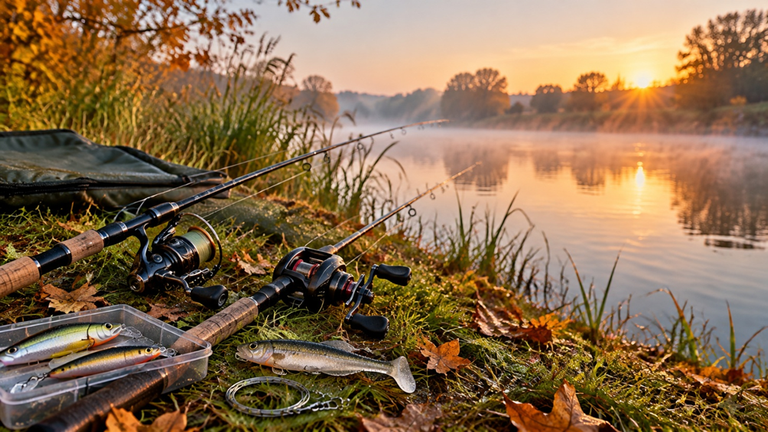
Pick your rod and reel by the heaviest lure you plan to throw, not by the fish on the label. For most pike, perch, zander and sea bass fishing in the UK, you need a 6–8 ft (1.8–2.4 m) rod rated for your lures, a fast to moderate action, and a size 2500–5000 spinning reel matched to the rod’s power.
Remember these three rules:
- Choose the rod by lure weight first.
- Choose the reel to balance that rod.
- Add a leader that suits the fish. Pike always need wire.
Quick-Pick Table
| Your target or situation | Rod length | Lure rating | Action | Reel size |
| Perch and small predators | 6–7 ft (1.8–2.1 m) | 1–15 g (up to ½ oz) | Fast | 1000–2000 |
| Zander, sea bass, small pike | 7–8 ft (2.1–2.4 m) | 15–40 g (½–1½ oz) | Fast to moderate | 2500–3500 |
| Pike with big lures | 7–9 ft (2.1–2.7 m) | 30–80 g (1–3 oz) | Fast to moderate | 4000–5000 |
| Deadbaiting from the bank | 9–12 ft (2.7–3.6 m) | 2–3 lb test curve | Moderate | 4000–5000+ |
| Kayak or tight cover | 6–7 ft (1.8–2.1 m) | Match your lures | Fast | Compact, 2500–3500 |
Start Here: Three Questions Before You Buy Any Predator Tackle
Most anglers shop by species label. A rod sold as a “pike rod” sounds right, but the label says very little. Your lures say far more. Answer these questions in order:
- What is the heaviest lure you will realistically throw? This decides rod power, reel size and line strength.
- Where will you fish? Bank, boat, kayak, tight cover or open water. This decides rod length.
- How will you present the lure? Casting, jigging, twitching or deadbaiting. This decides rod action and reel type.
Species comes after these three. A 3 kg perch and a 3 kg pike can both be caught on the same rod if you throw the same lure. The fish does not read the label. Your lure decides what works.
Step 1: Choose the Right Predator Fishing Rod
Spinning Rod or Baitcaster Rod? How to Decide
Spinning rods have larger guides, with the reel hanging below the blank. They suit lighter lines, finesse tactics, live bait and smaller lures of roughly 2–24 g. Casting rods have smaller guides and a trigger grip, with the reel sitting on top. They are built for a baitcaster and handle heavier lines, tighter accuracy and big baits of about 50–100 g and beyond.
| Feature | Spinning rod | Casting rod |
| Reel position | Under the rod | On top of the rod |
| Guides | Larger | Smaller |
| Best lure range | About 2–24 g | About 50–100 g+ |
| Best for | Light lures, finesse, live bait | Heavy lures, accuracy, big baits |
| Skill level | Beginner friendly | Needs practice |
Use this simple rule:
- If most of your lures weigh under 25 g, start with spinning.
- If heavy swimbaits and big jerkbaits fill most of your box, consider casting.
- If you are unsure, choose spinning. You can add a casting outfit later.
Be honest about the learning curve. A backlash happens when the spool spins faster than the line leaves it. It costs you fishing time and patience. Many good anglers catch predators for decades on spinning gear alone.
Rod Length: Match It to Your Water
Length controls casting distance and control. Longer rods cast further and give more leverage. Shorter rods are more accurate, easier in tight spots and less tiring.
| Situation | Best length |
| Kayak | 6–7 ft (1.8–2.1 m) |
| Boat | 6–8 ft (1.8–2.4 m) |
| Tight bankside cover, small rivers | 6–8 ft (1.8–2.4 m) |
| Open lake or wide river from the bank | 8–9 ft (2.4–2.7 m) |
| Deadbaiting, long-range casting | 9–12 ft (2.7–3.6 m) |
If you can only buy one rod, an 8 ft rod with a 15–40 g casting weight is a strong all-rounder. It has enough backbone to control a decent predator and is light enough to cast all day.
Official guidance agrees with this range. The Alaska Department of Fish and Game recommends a medium to medium-heavy rod of 6.5–8.5 ft, with moderate to fast action, for northern pike. A UK tackle retailer suggests 8–9 ft as a sensible length for anglers starting out with pike.
Rod Power: The Middle-Third Rule
Rod power describes how much force it takes to bend the rod. Manufacturers print a casting weight range on the blank, such as 15–45 g. That range is the most useful number on the rod.
Here is the method that prevents most bad purchases:
- Write down your three most-used lures.
- Find the heaviest one.
- Choose a rod whose range puts that lure in the middle third.
For example, if you mostly throw lures of 20–35 g, a rod rated 15–45 g fits well. A lure at the very top of the range overloads the rod and hurts casting distance. A lure at the very bottom feels lifeless and never loads the blank.
| Lure weight | Rod power | Typical target |
| 1–15 g | Light | Perch, small fish, micro jigs |
| 15–50 g | Medium to medium-heavy | Zander, sea bass, average pike |
| 50–100 g+ | Heavy | Large pike, big swimbaits, big deadbaits |
One retailer guide suggests a general-purpose pike rod rated 30–80 g. It also warns that many bass rods lack the strength to set hooks into a 15 lb (about 7 kg) pike or to throw big deadbaits.
Rod Action: Where the Rod Bends
Rod action describes where along the blank the bend happens.
- Fast action means only the tip bends. You get accurate casts and quick hook-sets. It suits single-hook soft plastics and jigs.
- Moderate or slow action means the bend runs deeper into the blank. It absorbs violent headshakes and helps treble hooks stay in the fish.
| Lure type | Best action |
| Soft plastics and jigs (single hooks) | Fast |
| Crankbaits and jerkbaits (treble hooks) | Moderate to fast |
| Big swimbaits | Moderate to fast, heavy power |
| Deadbaits | Moderate, rated by test curve |
Blank, Guides and Handle: A Five-Point Check
Two rods with the same length, power and action can feel completely different. Check these five points:
- Blank material. Carbon is lighter and more sensitive. Composite costs less and tolerates rough handling.
- Guides. Look for sturdy, braid-friendly guides spaced evenly along the blank.
- Handle. Cork feels light and warm. EVA foam is tougher and cheaper.
- Reel seat. It must lock the reel firmly, with no wobble.
- Weight. A rod that feels light in the shop feels lighter still at the end of a long session.
Ultra-light is not always better. For heavy predators, you want real backbone, not just the thinnest blank on the shelf.
Step 2: Choose the Right Reel
Spinning Reel Size Guide for Pike, Zander and Perch
Reel sizes such as 1000, 2500 and 4000 describe spool size. A bigger number means more line capacity, a larger drag system and more stopping power. It also means more weight.
| Reel size | Best rod power | Line | Best for |
| 1000–2000 | Light | 4–10 lb (2–4.5 kg) braid | Perch, small lures |
| 2500–3500 | Medium to medium-heavy | 10–20 lb (4.5–9 kg) braid | Zander, sea bass, small to average pike |
| 4000–5000+ | Heavy | 20–30 lb (9–13.5 kg) braid | Large pike, big lures, deadbaiting |
UK pike specialists use similar groupings. One predator-fishing resource lists:
- Size 1000 for ultralight 2–10 g outfits.
- Sizes 2500–3500 for 10–30 g rods.
- Sizes 3500–4500 or larger for heavy lure rods above 40 g and for deadbaiting.
A UK retailer’s starter-kit guide also puts general pike fishing at size 3000–4000. A Finnish pike rod rated 20–70 g is sold specifically for a size 3000 reel. These sources overlap, which is a good sign that the ranges are sound.
Size also affects comfort. A reel that is too heavy tires your wrist. A reel that is too small runs short of line and drag when a big fish runs.
Baitcaster Reels: Who Should Use One?
A baitcaster gives experienced anglers more control with heavy lures, better accuracy and the ability to handle bigger line classes with low-stretch braid.
Worth knowing before you buy:
- Low-profile reels sit comfortably in the palm and suit most casters. Round reels are bulkier and often used for the heaviest work.
- Magnetic brakes are easy to adjust and forgive mistakes. Centrifugal brakes give fine control once you have experience.
- Heavy lures are easier to cast smoothly on a baitcaster. Very light lures are not.
How to ease into a baitcaster:
- Start with a medium lure of about 20–30 g.
- Tighten the spool tension until the lure drops slowly.
- Raise the brake setting higher than you think you need.
- Thumb the spool at the end of every cast.
- Lower the brakes gradually as your control improves.
The Reel Specs That Matter More Than the Marketing
- Drag smoothness. A jerky drag loses fish, whatever number is printed on the box. The common guideline is to set drag at about one-third of the line’s breaking strain. For example, 12 lb line gets roughly 4 lb of drag.
- Braid and drag. Many anglers set the drag a little lower with braid, which has no stretch.
- The weak link. If your leader is weaker than your main line, set the drag by the leader.
- Gear ratio. A high ratio (around 6:1 or above) picks up line quickly and helps with slack-line control. A lower ratio gives more cranking power for deep divers and big baits.
- Spool design. Choose a braid-ready spool with a lip that suits thin line.
- Build quality. Sealed bearings and corrosion-resistant parts keep a reel smooth for years, especially when you fish dirty water or saltwater.
The 10-Second Balance Test
Clip the reel on, rest the rod across one finger just ahead of the handle, and watch where it settles.
- Tip dips down: the reel is too light for that rod.
- Butt drops down: the reel is too heavy.
- Sits close to level: you have a good match.
Poor balance causes fatigue and sloppy casts. Test it before you commit.
Step 3: Line, Leaders and Terminal Tackle
A great rod and reel will fail if the line between you and the fish is wrong.
| Line type | Strength | Weakness | Best use |
| Braid | No stretch, thin, strong, casts far | Visible, can fray on rough guides | Main line for most lure fishing |
| Fluorocarbon | Low visibility, abrasion resistant | Stiffer, costs more | Leaders for perch and zander |
| Monofilament | Stretches, cheap, forgiving | Thicker for its strength | Deadbaiting, beginners |
What to use for each species:
- Pike: always use a wire trace. The Pike Anglers’ Club of Great Britain says a wire trace of at least 18 inches (45 cm) should be used whether you fish lures or bait.
- Pike main line: the same club lists a minimum of 15 lb mono, or 20–30 lb braid, as basic kit.
- Swivels and links: Fisheries Ireland advises components that hold over 30 lb (13.6 kg).
- Perch: a fluorocarbon leader usually does the job. Step up to wire if pike share the water, because pike often grab perch lures.
- Zander: a fluorocarbon leader of about 10–20 lb (4.5–9 kg) is a common choice.
Two warnings:
- Braid wears quickly on poor guides. Good guides protect your line.
- A very stiff rod with no-stretch braid has nothing to absorb sudden shocks. A moderate action or a short fluorocarbon leader helps.
Fishing in the UK: Licence, Close Season and Water Types
Tackle only works when you can legally use it. These points matter to anglers across England and Wales.
- Rod licence. You need a valid Environment Agency rod licence to fish with a rod and line in England and Wales.
- River close season. Coarse fishing on rivers, streams and drains is closed from 15 March to 15 June inclusive. The same applies to some canals and certain SSSI stillwaters.
- Open waters. Most canals and stillwaters have no close season, so lake and canal predator fishing carries on.
- Match the water to the rod. Narrow rivers and canals favour shorter, lighter outfits. Big reservoirs and lakes favour longer rods and larger reels.
- Match the season to the setup. Many UK anglers use lighter lure outfits for perch in warmer months, then move to heavier pike tackle in autumn and winter.
Always check local byelaws and your fishery’s rules before you go.
Know Your Target: Pike, Perch, Zander and Bass
| Species | Typical size | Mouth and teeth | Typical lures |
| Pike | 2–10 kg, bigger in some waters | Many sharp teeth, needs wire | Jerkbaits, swimbaits, spoons, deadbaits |
| Perch | 0.2–1.5 kg | Small teeth, strong bite | Micro jigs, small soft plastics, spinners |
| Zander | 1–6 kg | Sharp teeth, bony mouth | Soft plastic shads, jigs, small swimbaits |
| Bass | 0.5–5 kg | No sharp teeth, big mouth | Soft plastics, minnows, small swimbaits |
A note on names. UK anglers usually mean sea bass when they say bass. In the US, bass means largemouth or smallmouth. Zander are the European cousins of the North American walleye. The lure-weight rule works for all of them. If you fish saltwater, rinse your gear in fresh water afterwards.
Ready-Made Predator Setups
| Setup | Rod | Reel | Line and leader | Typical lures |
| Beginner all-rounder | 7–8 ft, 10–30 g, fast to moderate | 2500–3500 spinning | 10–15 lb braid, 12–15 lb fluorocarbon or wire for pike | Soft plastics, small crankbaits |
| Light perch outfit | 6–7 ft, 2–10 g, fast | 1000–2000 spinning | 4–8 lb braid, 6–10 lb fluorocarbon | Micro jigs, small spinners |
| Dedicated pike lure outfit | 7–8 ft, 20–70 g, fast to moderate | 3000–4500 spinning | 20–30 lb braid, wire trace 18 in+ | Jerkbaits, spoons, big soft plastics |
| Big swimbait outfit | 7–8 ft, 50–130 g, heavy casting rod | Baitcaster, low gear ratio | 40–65 lb braid, strong wire or heavy fluorocarbon | Large swimbaits, big jerkbaits |
| Kayak or boat outfit | 6–7 ft, 15–40 g, fast | 2500–3500 compact | 15–20 lb braid, leader to suit | Soft plastics, small to mid lures |
| Deadbait outfit | 9–12 ft, 2–3 lb test curve | 4000–5000+ | 15 lb+ mono or 20–30 lb braid, wire trace | Deadbaits on float or ledger rigs |
Budget Guide: Where to Spend and Where to Save
Spend in this order: rod first, reel smoothness second, line and leaders third. A good rod makes casting easier and fish easier to control. A smooth drag saves fish. Line is the cheapest part to upgrade later.
- Entry level: composite or basic carbon blanks and simple reels. Fine for learning and occasional trips.
- Mid range: lighter carbon blanks, better guides, smoother drags and sealed bearings. Most regular anglers get the best return here.
- Premium: top-grade blanks, very low weight and refined drags. The jump from mid range is smaller than the jump from entry level.
Only one outfit? Buy an 8 ft rod rated 15–40 g, a size 3000 spinning reel, and braid with a suitable leader. It will catch perch, zander, sea bass and average pike.
Combos save money and guarantee a matched pair. The trade-off is that the rod or reel may be average. If you buy a combo, check the lure rating and reel size first.
Test Before You Buy: A 6-Step Shop Check
- Flex the blank gently. It should bend smoothly, not kink.
- Sight down the rod. The guides should line up in a straight line.
- Attach the reel. The reel seat must lock tight.
- Hold the outfit for a few minutes. Check weight, balance and handle comfort.
- Turn the handle and test the drag. It should be smooth and quiet.
- Ask the shop: “What lure weight and line does this rod handle best?”
Five Predator Tackle Myths, Checked
- Myth: Bigger reels always catch more fish. Fact: an oversized reel unbalances the rod and tires you out.
- Myth: Heavier line always lands more fish. Fact: line stronger than the rod’s rating can break the blank on a hook-set.
- Myth: Wire ruins lure action. Fact: a wire trace is the safe standard for pike, and the fish still take lures well.
- Myth: Baitcasters are only for experts. Fact: beginners can learn them, but spinning is the easier start.
- Myth: One rod does everything. Fact: one rod can cover a lot, but very light and very heavy work need different outfits.
Eight Common Mistakes When Choosing Predator Gear
| Mistake | Quick fix |
| Buying by species label only | Check the lure rating against your actual lures. |
| Using a rod too light for big lures | Put your heaviest lure in the middle third of the range. |
| Ignoring balance | Test the setup with the reel attached. |
| Overspending on the reel | Put more of the budget into the rod. |
| Using line too thin for pike | Follow the minimum line strengths listed above. |
| Moving to a baitcaster too early | Start with spinning and switch when your lures demand it. |
| Forgetting a leader | Add a wire trace for pike every time. |
| Ignoring the lure rating | Read the blank, not the marketing. |
Fish-Friendly Gear and Care
Tackle that is too light leads to long, exhausting fights. Tired fish recover slowly after release. The right power protects the fish as well as your line.
Pike need extra care. Angling Times lists pike among the species most easily harmed by poor handling. Use this kit:
- A large knotless landing net. The Pike Anglers’ Club recommends 42 inches or an equivalent oval net.
- A large, wetted unhooking mat or cradle.
- Long forceps and wire cutters.
- Barbless or pinched-barb hooks. Fisheries Ireland says they make unhooking easier.
Handling basics:
- Wet your hands and your mat before you touch the fish.
- Check where the hooks are before you lift it.
- Unhook quickly and return the fish to the water.
Care for your own kit:
- Rinse the rod and reel after dirty water or saltwater.
- Relubricate the reel regularly.
- Check guides for cracks.
- Store rods flat or upright, never leaning at an angle.
Frequently Asked Questions
What size rod is best for pike fishing?
A 7–8 ft (2.1–2.4 m) rod with a casting weight of about 20–70 g handles most pike lure fishing. Choose 8–9 ft for open water and longer for deadbaiting.
What reel size is best for pike?
A size 3000–4000 spinning reel suits general pike fishing. Go up to 4000–5000 for big lures, deadbaits or very large pike.
Is 20 lb braid enough for pike?
Yes, 20 lb braid is the practical minimum. Use 30 lb for extra margin around weed and snags, and always add a wire trace.
Do you need a wire trace for pike?
Yes. Pike teeth cut ordinary line. Use a wire trace of at least 18 inches (45 cm) for both lures and bait.
Is a baitcaster or spinning reel better for predator fishing?
A spinning reel suits most anglers and lures under about 25 g. A baitcaster gives more control with heavy lures but takes practice.
What length rod is best for beginners starting pike fishing?
A rod of 8–9 ft suits lure fishing and short to medium casts. Longer rods cast deadbaits further but feel harder to handle.
What is the best test curve for a pike deadbait rod?
A 2–3 lb test curve is typical for deadbaiting. Lure rods use a casting weight in grams instead.
Can you use a bass rod for pike?
A heavy bass rod can land smaller pike. Most lack the backbone for big pike or heavy deadbaits, so a medium-heavy pike rod is safer.
Final Thoughts: Start With the Lure, Finish With the Fish
Choosing predator tackle gets simple once you work backwards from the lure. Write down your three most-used lures and find the heaviest. Pick a rod that puts it in the middle third of the range, balance it with a reel of the right size, and add a leader that suits your target. Set the drag, check the balance, and you are ready.
Ready to Gear Up?
If you want help turning this guide into a real outfit, On Top Angling is a good place to start. The shop stocks fixed spool, multiplier and baitcaster reels, rods, lures, braid and fluorocarbon line, terminal tackle and the Westin deadbait range, so you can build a matched predator setup in one order. It also sells fish finders and kayaks, and runs guided kayak fishing trips for anglers who want to try predator fishing from the water with expert help.
Your next steps:
- Write down your three go-to lures.
- Pick your setup from the scenario table.
- Visit On Top Angling to browse the range, and ask the team if you need advice on your match.
About the Author